

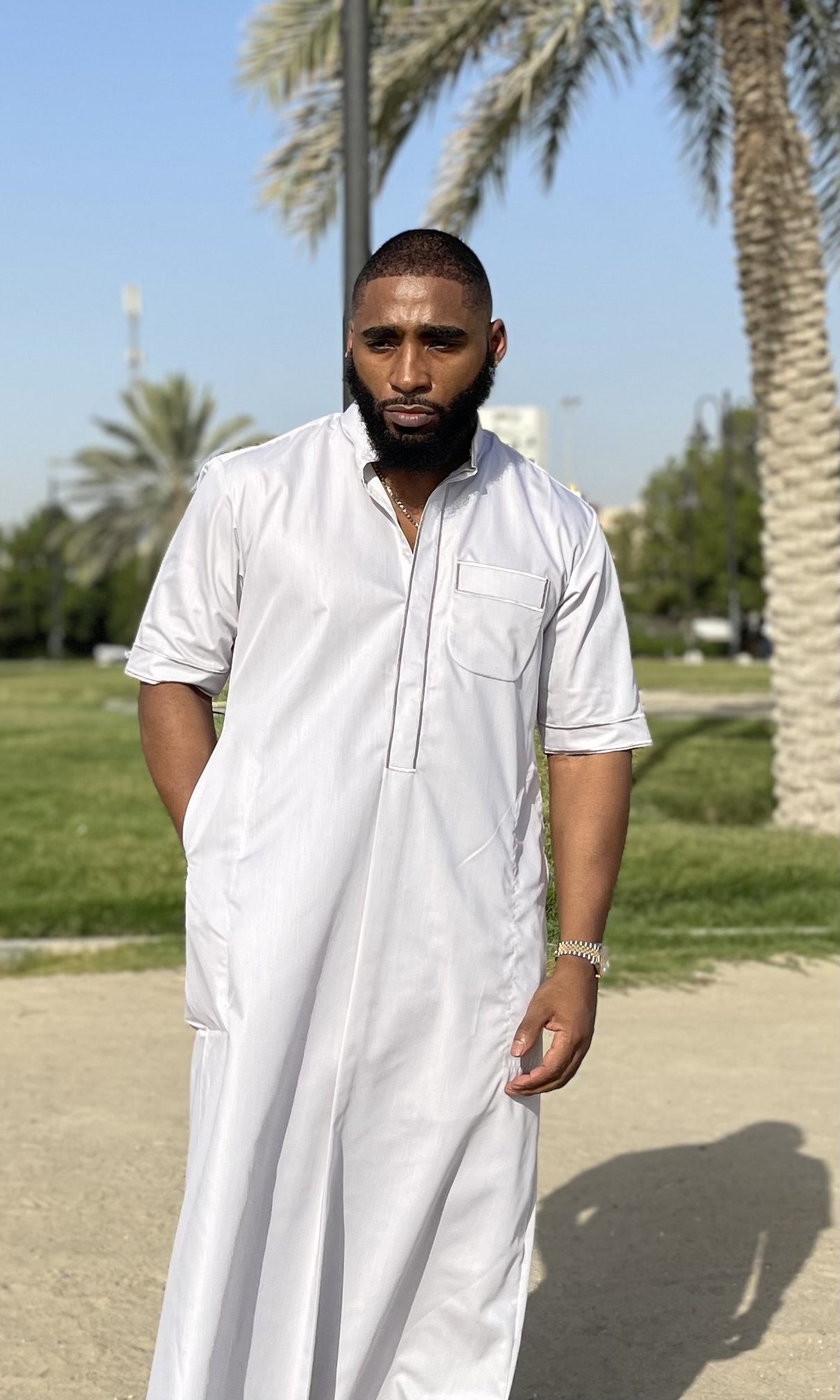
“U 2 Rare,” a fun fusion of R&B, hip-hop and rap with a soul vibe, is the product of a collaboration between Globalqtheartist, an R&B/trap/soul singer from Atlanta, and SDBoomin, beat maker and producer from Mobile, Alabama.
They have found each other in Kuwait, where they are collaborating on a set of five songs, of which “U 2 Rare” is the first. It will be released on July 9.
They approach the song in entirely different terms. One is theme, one is process.
“For me,” said SDBoomin, “‘U 2 Rare’ is one of those tracks where you’re giving women the confidence that you know that they sometimes seek. So it’s more of, ‘Hey, you’re a beautiful woman.’ You know? Understand that and move forward confidently. You’re rare.”
You look so good, you gotta be good for my health
(Baby too rare, you’re rare)
You really stood out in the crowd, couldn’t tell if you were real
I’m an introvert, but you pull me out of my shell
(Ooohhh yeah)
That right there is an old-school R&B concept. In “U 2 Rare,” it is presented in hip-hop beats, R&B rhythms and soul melodies.
For Globalqtheartist, the term that comes to mind is a beautifully technical term: “embellished reality.” (“That’s what art is. You start out with a skeleton, and then you start building around it and you make it interesting.”)
“I had to make up a name for how I write and how I create,” he said. “So, when I hear a track, first I’m trying to find what kind of melodies can I come up with. So, I’ll come up with a melody, and then next is like, ‘How does this track make me feel?’”
Next are key words, and, for this song, it was “rare.”
“And you know when you’re writing R&B and hip-hop, of course it’s got to be associated with a woman.”
And that triggered a memory, “this time back in the day when I was performing, and there was a woman in the crowd, and—I don’t know—I just took a liking to her.”
“She was just very different from how everyone else was dressed, how all the other women were carrying themselves. It was something about the way she wore her hair, how she carried herself. So, I decided to write a song based around that scenario.”
And in this way the lyrics of the singer/rapper and the beats of the producer combined to create music.
SDB began in music as a child producer and rapper. He and a brother formed a rap duo, eventually expanding the group. Later, after the group disbanded, he moved into a successful career in information technology, but, he said, the passion for music remained and endured through the loss of his two brothers.
“Once my second brother passed away a couple of years ago,” he said, “I felt like I should get back into it. That’s what got me here today, but I don’t rap as much as I used to. I’m on this producer side now.”
In the five-track collaboration, he is featured on two of the tracks.
Globalq is a singer and rapper with a reputation for his lyrical skills and performing techniques in the Atlanta area. He says he “is looking to bridge the gap between the musical styles of artists such as Future, Bryson Tiller and Brent Faiyaz.” He lists his main genre mix as R&B, trap and soul.
In the five-track mix they are working on, his vocals carry three.
“From my side,” said SDB, “I definitely wanted to collaborate with Q, and hopefully we collaborate more in the future. But, going beyond this, I want to continue to make beats, continue to work with other artists that are coming out and try to work my way into the industry to work with major artist.”
For his part, Globalq said he enjoys the work with SDB.
“The beats is dope, and the vibe is crazy,” he said. “We know how to feed off each other. I am focused now on our project. I’m not trying to become some megastar or anything like that. I just know that I’m good enough to compete in the industry, and wherever that takes me, I’m good with it.”
All except the last of the five songs are finished, and the fifth is close. Once “U 2 Rare” is released, they will release another every two or three weeks.
“I would give a compliment to Q,” said SDB. “Of these five songs that we’ve pushed out, the last song is still in progress, but over like a two-week period, Q pushed these songs out.”
He continued, “I mean, talk about somebody who can write, who can come up with some concepts.”
First, though, is “U 2 Rare.”
“I think it’s a great song,” said SDB. “Q really did a great job with the lyrics, as always. I think it’s one of those songs that will motivate women. I think I can see a lot of females putting it on their TikTok, using it as their background music.”
“I just know that it’s just a real fun song,” said Globalq. “Just like SDB was saying, I can definitely see women doing reels to it.”
See where they go. Connect to SDBoomin and Globalqtheartist on all platforms for new music, videos, and social posts.
SDBoomin:
Globalqtheartist:
-
Freddie Jackson Passes Away Just Days After Turning 70
-
Fans React To Glastonbury 2027 Coach Packages Selling Out Within 30 Minutes
“Why do I do this to myself every year?”
-
Watch Mike D, Money Mark and Mix Master Mike Perform Together in Los Angeles
The trio reunited for a rendition of 1992 single 'So What'cha Want'
-
Olivia Rodrigo’s Daisy Chain Fields Festival Raises $20 Million
-
Trivium and In Flames Reveal Dates for Major 2027 UK and European Tour
The tour includes a slot at Alexandra Palace next spring
-
Ice Spice Appears on Kanye West & Ty Dolla $ign’s ‘New Body,’ New Report Says
Kanye West and Ty Dolla $ign never got to release "New Body" with Nicki Minaj's verse.
-
MUNA’s Tour Bus Goes Up in Flames
-
Another Person Reportedly Linked to Death of Teen Found in D4vd’s Car
-
Warner Music Takes Legal Action Against Ray-Ban Over Unlicensed Music
-
The Slow Country’s Warm Alt-Folk Promises A Good Time
-
Robbie Williams Chosen As Album Icon For National Album Day 2026
-
blockboydoo's "mollysantana (willubemine)" Is a Self-Made R&B Breakout
That tension between the swagger of the title and the tenderness of its subject is the heartbeat of blockboydoo's music.
-
D-Block Europe Teams Up With French Montana for ‘Fully Loaded’
"Fully Loaded" by D-Block Europe and French Montana is a brief cut, but traded verses between these MCs make it feel grander.
-
Peezy Joins Forces With Babyfxce E On “I Can’t Tell”
-
Smiley Drops New Song "Two Tone"
Smiley is back with his new single, "Two Tone," which carries forth his signature style that has proven to be polarizing.
-
“U Dig Me” Marks Another Release From Kenny Muney
Kenny Muney is a Memphis artist whose new album "U Dig Me" is coming soon, and on Wednesday, the title track was released.
-
Cochise Brings a Fresh Sound on “Skin Care”
Cochise has fans demanding a new album soon, but at least he will hold them over for now with the new single "SKIN CARE."
-
Rocket Rese Drops Heavy New Collaboration "BAPTIZED" With SosMula
Rocket Rese shared his first project of his career this year and it doesn't look like he's going to slow down for the rest of 2026.
-
Dead Kennedys Guitarist Claims Jello Biafra Is Holding Back Potential Reunion
"It's not an issue for me or Klaus," founding Dead Kennedys guitarist East Bay Ray explains.
-
LE SSERAFIM announce 2025 ‘Easy Crazy Hot’ world tour
Featuring concerts in Asia, North America and more
-
Mischa Barton reveals she’s a huge Oasis fan: “They’re the coolest”
“What kind of self-respecting Brit would I be if I wasn’t?”
-
Eem Triplin drops “Duya” single ahead of upcoming album
Eem Triplin, once known for crafting type-beat internet productions, has smoothly transitioned into a full-fledged artist in his own right.
-
Kiana Ledé On Being Indie, ‘Cut Ties,’ And Singlehandedly Extending Spooky Season
The singer detailed how she intertwined love and horror for 'V Sessions.'
-
Royal Deb displays her Jamaican roots new reggae single “Somebody For Everybody”
Since Royal Deb was just a child in St. Ann, Jamaica, she has been immersed in the reggae music scene.



COMMENTS
Leave a comment