
.png)
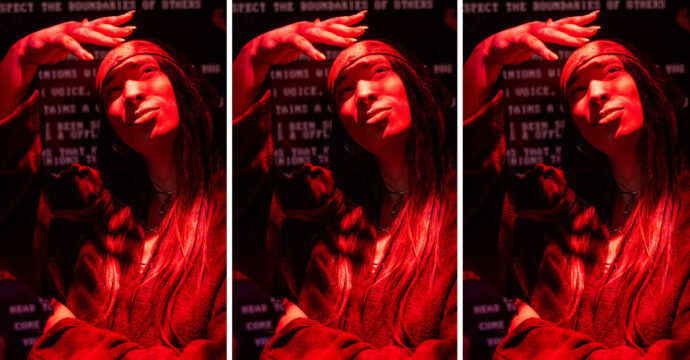




Danielle, as an artist working with animation and video games, do you think the perspective on technology as art is changing?
I appreciate video games with the same reverence as I would a painting by Francis Bacon. For me, there’s no difference, and I think I’m lucky enough to be living in a time where the art world is shifting; more and more, video games are being considered as a form of art. We’re also living in a very politically charged world, so it feels like that’s another point that allows me to fit in as an artist, because a lot of the games I’m creating and showcasing are about a conversation with the audience. My work focuses more on the mirror: the choices that you make, the self-affection that you can have. We want people to think about their morals or think about if they’re a good or bad person.
It’s less about the actual game and more about the questions the game asks you.
Right, conversation is the main goal and aim, it’s about trying to make the space a productive one. With my latest project for Serpentine Gallery, The Delusion, the game we’ve made is trying to get people to look at a stranger and ask them about censorship, or ask them about war, or ask them about weapons or hope or despair or loneliness. We want them to have a conversation about that. These are difficult interactions, which are very human in the end. The game has almost become like a mediator of the space to break down those barriers. It’s giving you the tools to have an actual conversation.
“If we made this game and no one played it, there’s no work there. The audience is such a vital part of it.”
It’s almost like the audience is a key collaborator for you.
It’s more than that, the audience is the work. When you come in and you’re doing something, that is the actual the work. So I wouldn’t even say that the audience is a key collaborator, they are the key. They are literally the final piece that goes in that makes it worth it. With a painting, the painting can stand in a room alone and it’s still the same work. But if we made this game and no one played it, there’s no work there. The audience is such a vital part of it. I wouldn’t be able to make something without thinking about the audience.
Have your audiences been receptive to these ideas?
I’m not sure what happens to everyone or if everyone has the same experience, but I hope that people are trying to have the conversations, whether it turns out to be good or bad.
Do bad conversations ever happen?
Well, we’re not trying to cultivate happiness. It’s a genuine thing, so if you have a conversation about something that’s frustrating, and you’re frustrated — that’s okay for us. We’re trying to let you be a bit messy. We’re trying to let you have an honest conversation, and you don’t have to leave that conversation feeling good. It could go either way, and it’s important that we don’t actually restrict that. When you have a conversation about dehumanization, it’s a very difficult, you’re not going to leave being like, “Oh, jolly me, that was such a fun chat!” (Laughs) But it’s what we need. We need spaces to have those conversations without the feeling that our repercussion could be losing our job, or our friends, or cancelation, or anything like this.
It’s definitely a different way of interacting with art than just going to a gallery to see a beautiful painting.
I think it’s just not my calling to make that kind of thing. There’s enough art like that in the world, art that makes people feel good and makes them say, “Oh, what a great painting, what a great show.” But to me, that exact review would be an absolute failure, because my aim isn’t for me to make the best show. I want to make something that actually affects you and makes you think about your place within the world, whether you’re a good or bad person. It’s not really about making something that’s inspiring or that just lets you forget about the world. It’s the opposite. I’m trying to highlight the things that are happening right now and just say, “Okay, you’re here for an hour. Think about it as much as you can right now. And when you leave the gallery, then you can rest.” So for me, the outside of the gallery, when you leave, that is your rest moment, that’s your moment of entertainment. But in the gallery, it’s work time. You are coming here to work through everything you’re seeing, the topics in the news, the topics we’re bringing up to you. It’s a lot, even if you had a good time. It’s an active space that doesn’t rely on enjoyment.
What about for you and the making of each game? Is there enjoyment in that, or is that also a time of struggle?
Well, with The Delusion in particular, it was very brutal. To create the game, we used an engine that isn’t really finished, so we wrote a lot of the engine ourselves. We kind of expanded everything we wanted to add in. For example, if there’s dialog with subtitles and a voice, we had to write the code to actually have that appear from scratch. Everything was very difficult, wading through mud and trying to find the work within that, rather than using a very simplistic system, as I previously did.


Apparently in your past work, you had a rule to only work on each element for 15 minutes, and then whatever is done in that timeframe has to be included in the game. Were you still able to abide by that rule?
That’s still very much the same this time, yes. It almost becomes like a diaristic practice because we have this rule that once it goes in, you can’t take it out. So even if an element or model is in there and it’s terrible, you have to figure out a way to make it not look terrible. So the style becomes really diaristic, sometimes very chaotic, oversaturated with images and details and text. It is a very direct process. So whatever was being felt in that moment, it’s kind of archived there. It’s a diary in one way, and it’s also a constant kind of questionnaire to the audience. It meant that we could iterate and make a lot more things, rather than spending like four hours rendering one character, we had a lot of space to make a lot of characters because of the restrictions we put on ourselves. And it also meant that the styles switch up so much as we learned how the engine worked and how to optimize it. It felt like the most expansive process we’ve ever had to with, and at the same time the most dangerous.
Is your work also diaristic in that the questions and choices we’re seeing are distilled from your thoughts, feelings, and reactions to the world around you?
Absolutely, I’m very reactionary. And when I see something, I need to process it in my art, just so I can get it out of me. It’s a big moment of trying to get everything out so it doesn’t have to live within my body. And then that’s kind of what you got to see in these games. It’s me trying to process a conversation I had, or something I read on the news, or a story someone told me, or just meeting a new person. I’m trying to process all that information and then collate it together in a collage that makes sense to you or holds a mirror up to you and reflects that back in some little way.
-
Bruce Springsteen Honors Joe Ely “We’ve Lost an American Classic”
Ely, a cornerstone of Texas music, passed away Monday at 78.
-
Diddy Reportedly Plans $1 Billion Legal Battle With Netflix Over 50 Cent’s Docuseries
According to Diddy’s representatives, the Netflix docuseries produced by 50 Cent is a “shameful hit piece,” and they argue it uses footage that was stolen from them.
-
Oasis’ Video Director Opens Up About Live ’25 Planning, Saying It Took 14 Months And Held “Well Kept Secrets”
Fans joked that the Gallaghers had “tricked” them into believing they weren’t speaking before the shows were announced.
-
Babyshambles Celebrate Patrick Walden at Their Massive Brixton Concert
Following the triumphant performance, drummer Adam Ficek shared that the evening played a key role in helping him and the band work through their grief.
-
De La Soul Unveil Cabin in the Sky, Describing Their New Album as “Therapy and Celebration”
The group returns with “The Package,” a new track from their 10th studio album, set for release on Nov. 21.
-
Finesse2tymes arrested in Texas for alleged drug offenses
Finesse2tymes is facing multiple charges, including possession of controlled substances and tampering with evidence.
-
Taylor Swift Drops New Easter Egg Hinting At Another Album
Taylor Swift has once again sent fans into full detective mode after a split second moment in the finale of her Disney+ docuseries End of an Era appeared to quietly suggest that another new album could already be taking shape.
-
Fabolous Disses 50 Cent In Freestyle With Maino, Jim Jones & Dave East
Rapper/podcasters Fabolous, Jim Jones, Maino, and Dave East decided to turn their beef with 50 Cent into a freestyle over his beats.
-
Peter Rosenberg Says Nicki Minaj’s “Monster” Verse Is Overhyped
Peter Rosenberg and Nicki Minaj have clashed before, but this latest tweet from Peter appears to be driven by more recent developments.
-
Scott David Roberts Releases “Wings of Angels,” a Spiritual Tribute Born From Loss, Hope, and Faith
Roberts began writing “Wings of Angels” just weeks before the passing of his second brother earlier this year.
-
Gracie Abrams Teams Up With Aaron Dessner and Bon Iver for Charity Release
Gracie Abrams, Aaron Dessner and Bon Iver have come together to honour victims of gun violence in the United States with a newly released charity song.
-
JayDaMasah Uplifts with Afrobeat Single, ‘Kontrol’
Liberian-American musician and songwriter, JayDaMasah, delivers an inspirational, new Afrobeat single, “Kontrol,” reminding listeners to seek guidance over control.
-
“Paper Low” Is DaBaby’s Latest Track
-
Introducing “44 Bars,” the Latest Release from Ludacris
Ludacris surprised fans with an early holiday gift in the form of “44 Bars,” a nonstop display that proves his writing skills are as sharp as ever.
-
Trippie Redd’s Song ‘Can’t Count Me Out’
Trippie Redd is building up to his new album “NDA,” and “Can’t Count Me Out” makes it clear he is performing at his peak.
-
Road Nights: A Track by Bone Thugs-N-Harmony
Bone Thugs-N-Harmony are stepping back into the spotlight as they get set to release their first project in four years.
-
Listen to Long Time (Roddy Lima Extended Remix) by Teyana Taylor and Roddy Lima
Teyana Taylor drops a remix of one of the big tracks from "Escape Room," her first album in five years.
-
Dave Blunts Shares His Inspiring New Single ‘Bigger’
Dave Blunts has earned a reputation as one of hip-hop’s most controversial figures, and he continues to divide listeners with his unapologetic approach.
-
Dead Kennedys Guitarist Claims Jello Biafra Is Holding Back Potential Reunion
"It's not an issue for me or Klaus," founding Dead Kennedys guitarist East Bay Ray explains.
-
LE SSERAFIM announce 2025 ‘Easy Crazy Hot’ world tour
Featuring concerts in Asia, North America and more
-
Mischa Barton reveals she’s a huge Oasis fan: “They’re the coolest”
“What kind of self-respecting Brit would I be if I wasn’t?”
-
Eem Triplin drops “Duya” single ahead of upcoming album
Eem Triplin, once known for crafting type-beat internet productions, has smoothly transitioned into a full-fledged artist in his own right.
-
Kiana Ledé On Being Indie, ‘Cut Ties,’ And Singlehandedly Extending Spooky Season
The singer detailed how she intertwined love and horror for 'V Sessions.'
-
Royal Deb displays her Jamaican roots new reggae single “Somebody For Everybody”
Since Royal Deb was just a child in St. Ann, Jamaica, she has been immersed in the reggae music scene.


COMMENTS
Leave a comment