








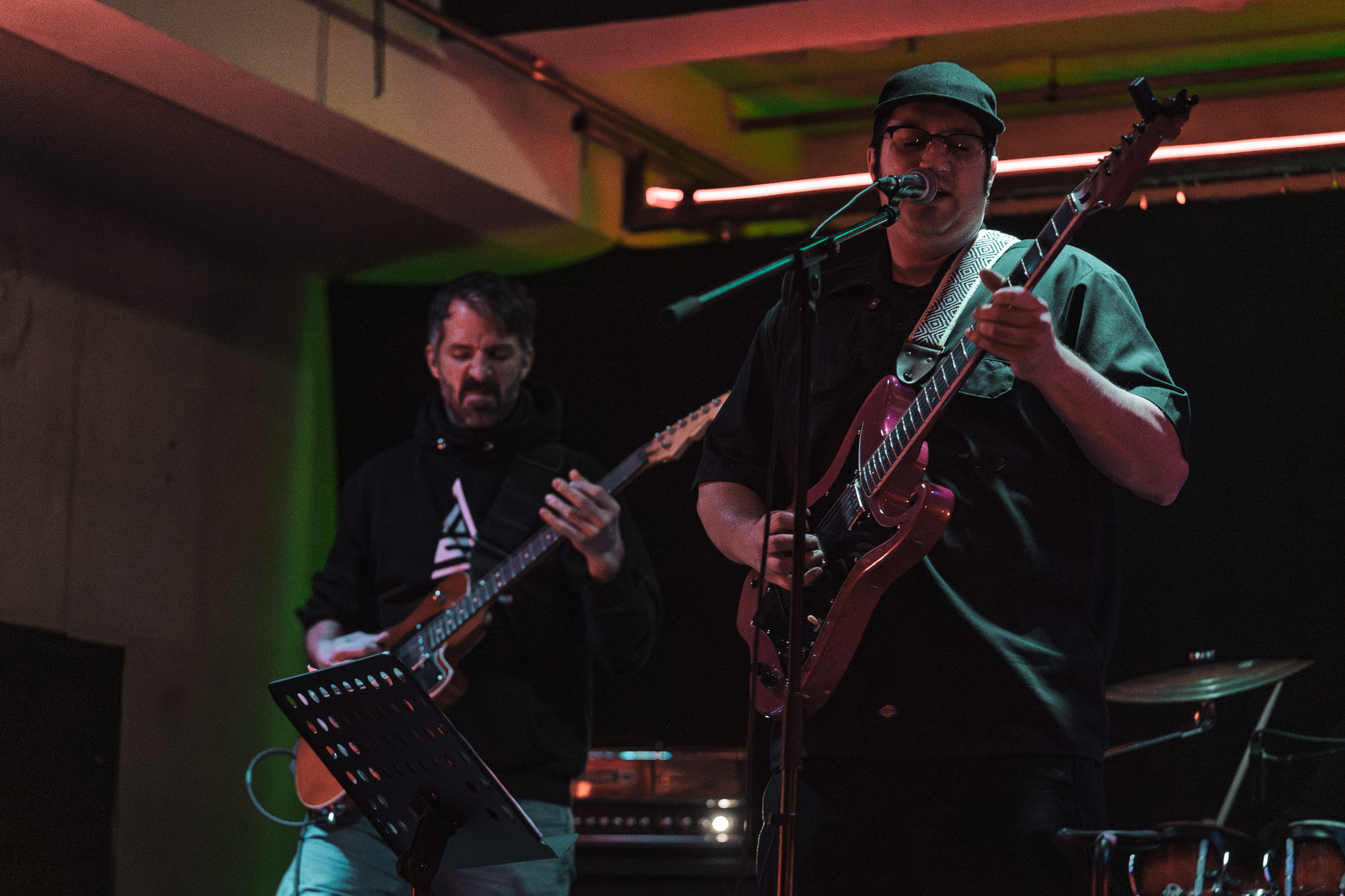
Greek electric rock band Citizen Jim unveils their new single “Tossed Away,” blending English and Greek lyrics for the first time as they expand their reach to a worldwide audience. Charged with relevance to today’s turbulent socio-political climate, the track challenges the very systems we rely on — drawing stark parallels between schools and prisons, which can both serve as cages and spaces for learning, shaped as much by the institution as by the individual. Within this lens, “Tossed Away” digs into the brutality of primitivism, the pull of tribalism, and even stretches into a critique of anthropocentrism: the belief that humans are the central force on Earth.
“The lyrics jump from topic to topic — the absence of spirituality and esotericism, fear, ignorance, the looming specter of war, and even ecological collapse,” shared lead band member Politis Dimitris. “As far as the education system, it’s something I noticed studying psychology, and something we reflected in the lyrics: ‘schools are prisons and prisons are schools.’ Education is extremely important - in theory, it’s awesome; it seems to be the best we can do as a society. But in practice, it doesn’t always work. People can actually be turned off by it. Those who have knowledge are often isolated. On the other hand, in prison, you can still learn a lot, even though it’s a harsh environment.”
The music itself mirrors the song’s deeply inquisitive and introspective themes. “Tossed Away” takes an experimental electronic approach, with an arpeggiated bass synth forming the backbone, while the drums provide a second core layer for guitars and vocals to unfold. A standout moment comes in the mid-ambient breakdown, where spiraling echoes, reverbs, and alternating filters transform the synthesizers, before the full instrumentation gradually cycles back in and fades out, creating a layered, immersive listening experience.
“Musically, we’re always trying different things. There aren’t any tracks on the album with this direction; we only have one in this style. It starts with a rock style and then develops into an electronic sound. We’ve only done this once before, so this is the second time,” said Dimitris.
“Tossed Away” is the third single from their latest album Dreamcatcher (Oniropagida in Greek). The record mixes Greek and English songs with “Tossed Away” as a striking bilingual track, another in English, and the rest in Greek. Lyrically, it marks a notable evolution for the band, particularly given that Dreamcatcher is their sixth album, since they first began making music together in 2017.
“As far as producing, we haven’t worked with a specific producer yet — we write our own material and then go into the studio to record. It’s all independent,” continued Dimitris. “We always know the energy we’re looking for in the studio, but in the end, it all depends on the band and the choices each member makes — from the sound to the instruments. We do work with two specific engineers, and this song was recorded with the one we’ve collaborated with the most.”
The track’s video was created by artist Thetis Parmenidou and features puppetry drifting through a cosmic landscape. It blends fragmented 2D collages with a recorded puppet performance, seamlessly stitched together with visual effects and montage techniques. The result evokes archetypal storytelling, using roleplay to explore how history is remembered and interpreted.
“Thetis is incredibly talented. We trust her very much. This is the fourth video we’ve done with her. She and I brainstormed the concept and developed it together. Many of the ideas came from me, but she brought them to life, edited them, and created an entirely new world,” enthused Dimitris.
In addition to their new single, music video, and latest album, the band is keeping busy with a packed schedule. They have a festival coming up in Athens, Greece, in just two weeks, a mini-tour in Japan this November, and two more concerts before the end of the year — including a release show in December. On top of that, they’re already planning a European tour for as early as spring 2026.
Citizen Jim was started by Politis Dimitris, who serves as the band’s lyricist and second guitarist. “Citizen” reflects both a personal and collective desire to engage with social issues, while “Jim” hints at the band’s global outlook, drawing from the anglicized version of Dimitris. What began as Dimitris’s solo project has since evolved into a full-fledged band, rounded out by a lead guitarist, bassist, drummer, and keyboardist, each contributing to the group’s dynamic and eclectic sound.
On what he hopes listeners take away from his music, Dimitris offered a thoughtful reflection: “I hope to make people think about something they wouldn’t have before listening to the song. I don’t want to make people feel depressed — I hope it’s more of a positive engagement than a negative one. Art for art’s sake is fine; sometimes I enjoy something light, like a comedic movie. But I believe it’s more important to create art that feeds the soul and helps you grow as a person.”
-
Ice Spice Appears on Kanye West & Ty Dolla $ign’s ‘New Body,’ New Report Says
Kanye West and Ty Dolla $ign never got to release "New Body" with Nicki Minaj's verse.
-
Angine de Poitrine Spark Another Viral Moment With Surprise Billboard Canada Awards Appearance
The mysterious duo picked up the Global Breakthrough prize at the Toronto ceremony
-
Everywhere At Once Adds Fatboy Slim, Lucy Spraggan, Gene, D Double E, And More To Massive Festival Bill
They join The Lathums, Becky Hill, Rizzle Kicks and more in a line-up that supports grassroots music venues across the country
-
Red Hot Chili Peppers Land Over $300 Million From Catalog Sale
Warner Music Group, the band's home since 1991's Blood Sugar Sex Magik, acquires the Peppers' catalog as part of Bain Capital joint venture
-
Guns N’ Roses Debut Nothin’ And Atlas At Tour Opening Show
Guns N’ Roses Debut Nothin’ And Atlas At Tour Opening Show
-
Turning Point USA reveals performers for its All-American Halftime Show
Turning Point USA first revealed plans for its Super Bowl Halftime Show alternative in October.
-
Leonard Cohen Estate Criticizes Trump For Using "Hallelujah" Without Permission
-
Konyikeh Lets Her True Self Shine Through Her Music
The contemporary singer has spent most of her life learning rules, but with her third EP ‘Cinere’, she’s finally allowing herself to break them
-
Dua Lipa and Callum Turner Reveal Stunning Wedding Photos in Sicily
"Mr & Mrs," the pop superstar captioned a gallery from the couple's second wedding celebration.
-
Oliver Tree’s Mother Pays Tribute After Post Malone Dedicates Toronto Show to Him
Tree died in a helicopter crash last weekend, aged 32
-
Fred Again.. Launches Free Music Production Workshops For Trans+ Artists In London
“This is an event to be celebrated for who you are and have a chance to learn from leading professionals in your field”
-
Harry Styles Calls Meltdown Festival Orchestral Set a Career Highlight
-
“U Dig Me” Marks Another Release From Kenny Muney
Kenny Muney is a Memphis artist whose new album "U Dig Me" is coming soon, and on Wednesday, the title track was released.
-
Cochise Brings a Fresh Sound on “Skin Care”
Cochise has fans demanding a new album soon, but at least he will hold them over for now with the new single "SKIN CARE."
-
Rocket Rese Drops Heavy New Collaboration "BAPTIZED" With SosMula
Rocket Rese shared his first project of his career this year and it doesn't look like he's going to slow down for the rest of 2026.
-
BOAT REMIX – Song by Trim & Pooh Shiesty
Trim's "BOAT" gained a lot of motion last year, and now we have a 2026 remix with none other than Pooh Shiesty.
-
Everybody Ain't Gone Get You - Song by JasonMartin
Jason Martin and DJ Flippp are gearing up for their new project "Quik Flip," and their new single "Everybody Ain't Gone Get You" is here.
-
SZA Releases “Save The Day” (From “Hoppers”)
-
Dead Kennedys Guitarist Claims Jello Biafra Is Holding Back Potential Reunion
"It's not an issue for me or Klaus," founding Dead Kennedys guitarist East Bay Ray explains.
-
LE SSERAFIM announce 2025 ‘Easy Crazy Hot’ world tour
Featuring concerts in Asia, North America and more
-
Mischa Barton reveals she’s a huge Oasis fan: “They’re the coolest”
“What kind of self-respecting Brit would I be if I wasn’t?”
-
Eem Triplin drops “Duya” single ahead of upcoming album
Eem Triplin, once known for crafting type-beat internet productions, has smoothly transitioned into a full-fledged artist in his own right.
-
Kiana Ledé On Being Indie, ‘Cut Ties,’ And Singlehandedly Extending Spooky Season
The singer detailed how she intertwined love and horror for 'V Sessions.'
-
Royal Deb displays her Jamaican roots new reggae single “Somebody For Everybody”
Since Royal Deb was just a child in St. Ann, Jamaica, she has been immersed in the reggae music scene.




COMMENTS
Leave a comment